If you’re like me and you saw Christopher Nolan’s epic Oppenheimer this weekend then it’s probably safe to say that your brain is STILL recovering from the onslaught of scientific information, rapid-fire dialogue and existential quandaries that make up the three hour masterpiece of cinema. Honestly, I think it broke my brain… in a good way!

I am haunted by the spectacular imagery and the impeccable sound design which essentially made “sound” another character in the story. The acting and storytelling should easily garner Academy Awards for Cillian Murphy (Best Male Actor in a Leading Role) and Christopher Nolan (Best Adapted Screenplay). In fact, Oscars all around!
In addition to all those obvious accolades, I have to salute Nolan’s use of symbolism. Here’s where I’ll insert a quick…

The repeated use of rain drops falling to mirror Oppenheimer’s imaginings of bombs dropping all over the world is simple, direct and terrifying. The scene in which Oppenheimer is breaking crystal goblets in order to observe how they shatter is made even more chilling with the excellent sound design highlighting the unsettling sound of the glass hitting the floor. The use of stomping feet in the gymnasium scene creates a raucous and festive atmosphere that borders on feverish with a strong undercurrent of unbridled nationalism. These aren’t the feet of soldiers marching in time to the front. These are the folks who fought the so-called “war at home” and this was their moment of triumph. Their celebration is in direct contrast to Oppenheimer’s steely demeanor as he deals with his conscience and the tens of thousands of lives that ended because of him. It makes my stomach churn just thinking about it.
I wasn’t kidding. I am haunted by this film.
While we’re on the topic of symbolism and the idea of breaking things (that’s a feeble attempt at a physics joke… fission… get it?), I want to shout out the production department for their inclusion of a few paintings from the 20th century Avant Garde. In an early scene, we see J. Robert Oppenheimer perusing a gallery in a non-descript museum. He walks past a few cubist paintings and then stands in front of a Picasso.
Which Picasso? This Picasso…
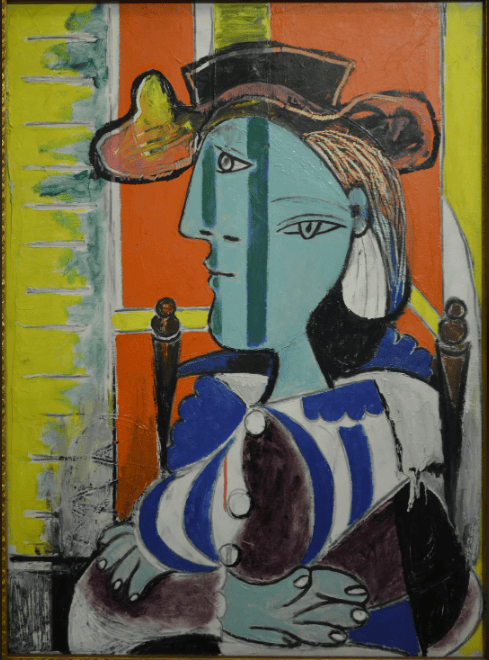
Woman Sitting with Crossed Arms from 1937. Why does he stare at this painting? Could there be any symbolism behind the choice to have J. Robert Oppenheimer contemplating a Picasso?
I’ll include an ARTnews article that discusses this further, but I’d also like to offer my perspective. Cubism is a result of the early 20th century Modern approach to art that originated with the rebellious Impressionists the century before. A new century brought with it a new way of looking at art and the cubists were leading the charge. Abandoning realism, they worked diligently at seeing and painting objects from every angle at once.
Impossible? I’ll explain it like this…
To see a three dimensional object from all sides at once is impossible unless you break it. Smashing a 3D object reduces it back to two dimensions and results in small, geometric shapes that loosely resemble the original object. Of course, when reassembling the object, not every piece goes back quite the same way. It’s like putting together a puzzle in which the pieces are damaged and no longer fit and some pieces are missing all together.
See, we’re breaking things – fission!
Why would the cubists be drawn to seeing the world in this way? Remember – artists don’t create the zeitgeist, they react to it. What possible events could these artists be reacting to? If you said, ‘Why, the horrors of WW1, of course!’ then gold star for you! Once you smash a globe via world war, how do you put the pieces back together? Can life ever be the same as before the war? Can humanity go back to “normal” after experiencing a collective trauma?
Yes, I believe that including this brief scene was a visual way of showing “game recognize game,” as the kids say, or “genius acknowledging genius.” Both Oppenheimer and Picasso thought differently about their respective fields, physics and art, and that new way of thinking changed the direction of not only those fields but the world at large. However, I think it is a subtle nod to the fact that while challenging times (like a world war) can inspire humans to do great things, they can also bring out the very worst in humanity. For me, this feels all but confirmed by the inclusion of an extremely brief shot of Oppenheimer reading T.S. Eliot’s The Waste Land, the poet’s ode to the atrocities of war.
What are your thoughts? Did you see Oppenheimer or do you plan to see it? Did you catch the cubist paintings on your first viewing? Let me know what you think in the comments!
Here’s the article from ARTnews…
https://www.artnews.com/art-news/news/oppenheimer-picasso-painting-scene-meaning-1234675202/

 The Wandering Art Historian
Excellent review Adrienne.
I would say this film deserves multiple Academy Award nominations. In addition to the ones you suggest, I will add a nomination for sound and editing. Brilliant and haunting. The film is packed with so much information and details.
The Criterion Channel has made available for free the 1981 documentary “The Day After Trinity”. The movie is true to the documentary which has interviews of many of the people who worked on The Manhattan Project at Los Alamos. Toward the end of the doc they interviewed residents of Alamogordo which I found fascinating.
Yes, I did appreciate seeing the Picasso in the film. Your interpretation has made it so much more intriguing.
Thank you!
LikeLiked by 1 person
Thank you for your thoughts, Sandy, & for the doc recommendation! 🙂
LikeLike
Another observation about Oppenheimer and the art world:
Los Alamos is located near Abiquiu, New Mexico (and Ghost Ranch) where Georgia O’Keefe had her home. Early in the film they showed several shots of Pedernal Mountain. It’s that very distinct and recognizable flat-topped mountain that Georgia O’Keefe painted numerous times. I recall learning that she felt it was her mountain. We had the good fortune to visit Abiquiu and Los Alamos a few years ago, a fascinating adventure.
Art vs. science
The beauty of the dessert vs. the harshness
Haunting!
LikeLiked by 1 person
WOW! Good observation, Sandy!
LikeLike